

Predicting next week’s harvest with computer vision and AI
In this article, protected cropping project partner Siddharth Jadav (Polybee) reports on a novel AI-driven approach to week-ahead yield forecasting is delivering greater than 85% accuracy in greenhouse tomatoes, with autonomous drone-based data collection for strawberries now operational in Tasmania.
The forecasting problem
If you manage a greenhouse tomato operation, you know the stakes of getting your weekly yield forecast wrong. Overestimate, and you are scrambling to source produce from imports or local growers to honour retailer commitments, or worse, losing credibility with buyers. Underestimate, and the surplus sells at a discount after harvest, or ends up as waste. Either way, the margin takes a hit.
Near-term yield forecasting (one day, three day, and one week ahead) sits at the centre of every pricing negotiation, sales volume commitment with retailers and logistical planning for transportation and packaging. And yet, for most protected cropping operations in Australia, this process still relies heavily on the experience and intuition of crop managers walking rows and making manual estimates.
Polybee, an agricultural technology company, is building a different kind of solution.
Funded as part of the Hort Innovation Frontiers Growing Horticulture through Protected Cropping Innovation program ( AS23001), and working alongside Flavorite Group for tomatoes and Hillwood Berries for strawberries, Polybee has been developing and validating a computer vision and AI system that forecasts greenhouse yield a full week in advance, with rigour and repeatability that manual methods cannot match.
The latest results present the most substantive evidence yet that this approach shows promise to work at commercial scale.
The core idea: sub-sample, classify, forecast
The method rests on a simple but powerful principle. Rather than attempting to scan every plant in a greenhouse, Polybee’s system captures detailed visual data from a random sub-sample of approximately 10% of the plant population in a compartment. Prior work in this project established empirically that this sub-sampling approach accurately represents the yield profile of the full population.
In a tomato glasshouse, mobile cameras mounted on trolleys travel through rows, capturing images of fruit clusters. In strawberry tunnels, autonomous drones perform the same function from the air. The computer vision system does not just count fruit. It classifies every visible cluster by ripeness stage, estimates fruit size and weight, and tracks subtle colour changes over time.
This is where the forecasting logic comes in. A day-before forecast essentially asks: how many clusters are ripe enough to be harvested tomorrow? For a week-ahead forecast, the question is harder: how many clusters that are not yet ripe today will cross the harvest threshold in the next seven days? To answer that, Polybee uses empirically determined ripening speed models, calibrated against micro-climate conditions in the greenhouse. The system observes clusters’ current ripeness, applies the expected ripening trajectory, and allocates clusters to the upcoming harvest window.
Results: Two seasons, strong correlation, commercially relevant accuracy
In the 2024/2025 season, the model achieved a correlation of R = 0.92 against actual weekly harvests over a 12-week period. The average deviation from ground truth was 13%. In the 2025/2026 season, results improved. Over the first eight weeks of data (the study remains ongoing through May), the model’s average deviation dropped to 10% and demonstrates promise to continue improvement.
The takeaway: a computer vision system scanning a fraction of the greenhouse on a single day can produce a week-ahead yield forecast that correlates strongly with actual harvest outcomes. These are results from commercial-scale glasshouse operations producing real volumes for real retail supply chains.
Strawberries: Autonomous drones, a new frontier
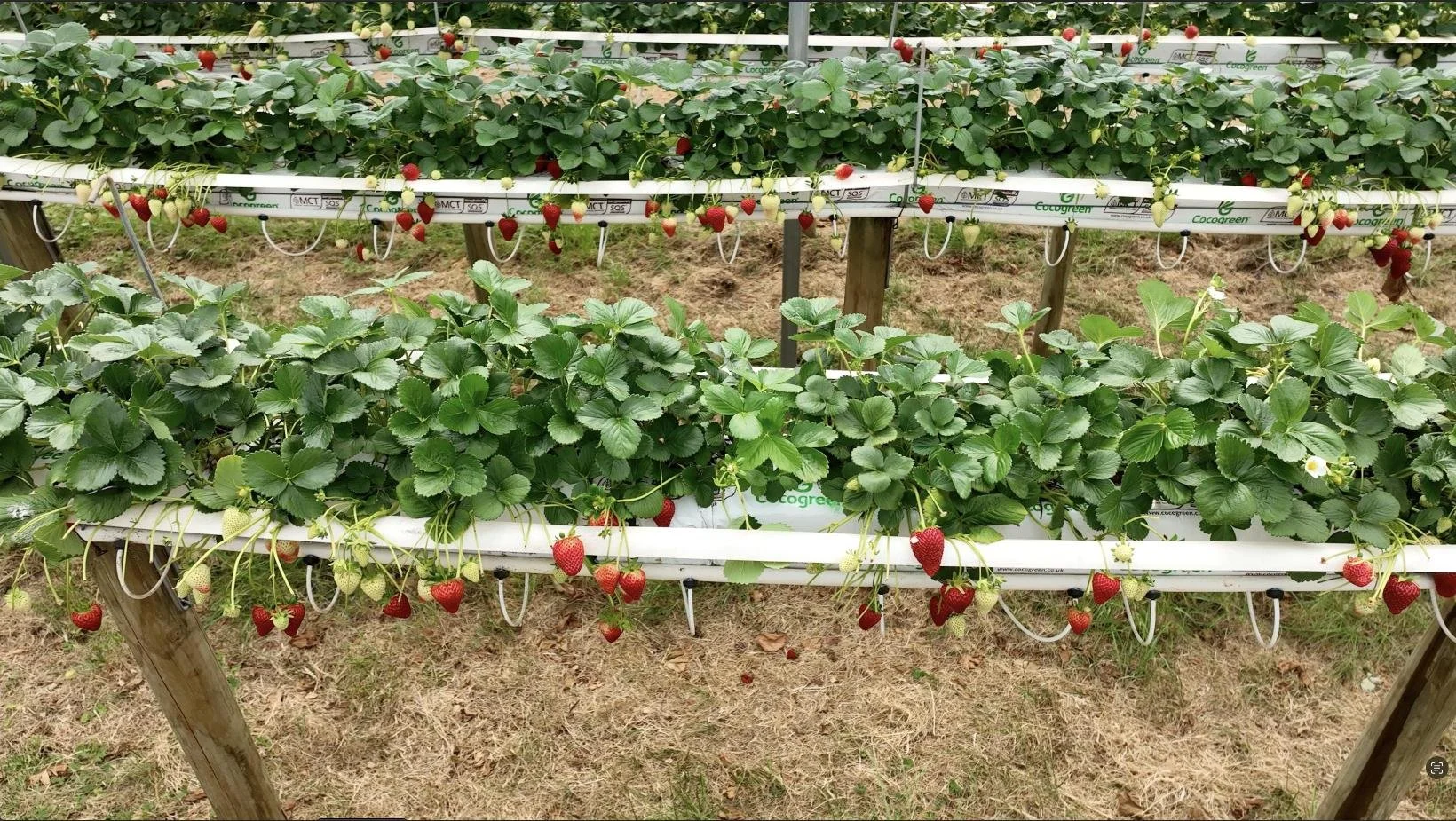
The strawberry work tells an equally compelling story, though from a different angle. Polybee has partnered with Hillwood Berries in Tasmania to extend its yield forecasting methodology to strawberry production in polytunnel greenhouses. The production season runs from December through May, and data collection is well underway.
What has emerged is an industry first: a fully autonomous, self-recharging drone system that collects crop data daily in a strawberry polytunnel without any manual intervention. The drones fly pre-programmed routes, navigate around dynamic obstacles like tractors and forklifts, return to their charging stations, and repeat. Over one representative month, the system achieved an uptime of 86.8% at a brand-new site, missing only a single day of data collection.
Hillwood Berries contributes something equally rare on the ground truth side: row-level yield data, meaning the weight harvested per pair of rows is documented. This granularity enables nuanced model validation across cultivars, micro-climate effects on fruit development, and performance benchmarking that would be impossible with facility-level aggregate data alone. Week-ahead forecasting analysis for strawberries is still in progress, with results expected by the end of the current growing season. But the autonomous data collection infrastructure is proven, and the foundation for extending the tomato forecasting methodology to a second crop type is firmly in place.
Why this matters for growers
The commercial value of accurate week-ahead forecasting is difficult to overstate. It is the critical planning horizon for sales decisions. A reliable week-ahead forecast allows a greenhouse operation to commit volumes to retailers with confidence, reduce emergency sourcing at premium cost, minimise post-harvest waste from surplus, and optimise labour scheduling for harvest crews.
The approach Polybee is developing does not require growers to instrument every row or install permanent sensor arrays. A camera on a trolley (for tomatoes) or an autonomous drone (for strawberries) scans a representative sample, and the system delivers a forecast. The data collection is designed to integrate into existing farm workflows, not disrupt them.
The Growing horticulture through protected cropping innovation program (AS23001) is funded through Hort Innovation Frontiers with co-investment from Applied Horticultural Research (AHR), Flavorite Hydroponic Tomatoes, The Costa Group, Apex Greenhouses, The Victorian Department of Energy, Environment and Climate Action (DEECA), PolyBee and contributions from the Australian Government.
The program will help protected cropping growers maintain profitability by delivering key aspects of the Protected Cropping Strategic Investment Plan, specifically sustainability, advanced agronomy, automation to reduce labour costs, energy and improving staff skills and management.